Ingleside Terraces Home Prices: Why Three Medians Matter
August 13, 2026
August 13, 2026
Pull up three real estate sites for Ingleside Terraces on the same afternoon and you will get three different median prices, and none of them will be close. One tracker puts the median sale price at $3.0 million for homes that closed in January 2026, up 63.3 percent from a year earlier. Another, looking at the trailing twelve months of closed sales, puts the median closer to $2.24 million, up 9 percent, with homes moving off the market in an average of 18 days against a 54-day national pace. A third, which counts only active listings rather than completed sales, shows a current asking-price median of $1.98 million, down 14 percent from the month before.
Same 750 or so houses. Same curving streets built around an old racetrack oval. Three numbers that would put a buyer in three different budget conversations depending on which tab happened to be open.
None of these figures is wrong. They are measuring different things, over different windows, in a market too small to produce one stable answer. Understanding why matters more than picking a winner, because it tells you how to actually read pricing in a neighborhood like this one instead of anchoring on whichever number loaded first.
The disagreement comes from two separate variables stacking on top of each other: the time window and the type of price.
| What's measured | Time window | Reported figure |
|---|---|---|
| Closed sales | Single month (January 2026) | $3.0M median, up 63.3% year over year |
| Closed sales | Trailing 12 months | $2.24M median, up 9% year over year |
| Active listings (asking price) | Current snapshot | $1.98M median, down 14% month over month |
The first two numbers are both measuring completed sales, but one is a single month's worth of closings and the other smooths over a full year. The third number is not a sale price at all. It is what current sellers are asking for homes that have not sold yet, which moves for entirely different reasons than what buyers actually paid last month.
In a neighborhood with a large, steady flow of transactions, these three approaches would converge on roughly the same figure. In Ingleside Terraces, they do not, because the flow of transactions is never large enough to average out.
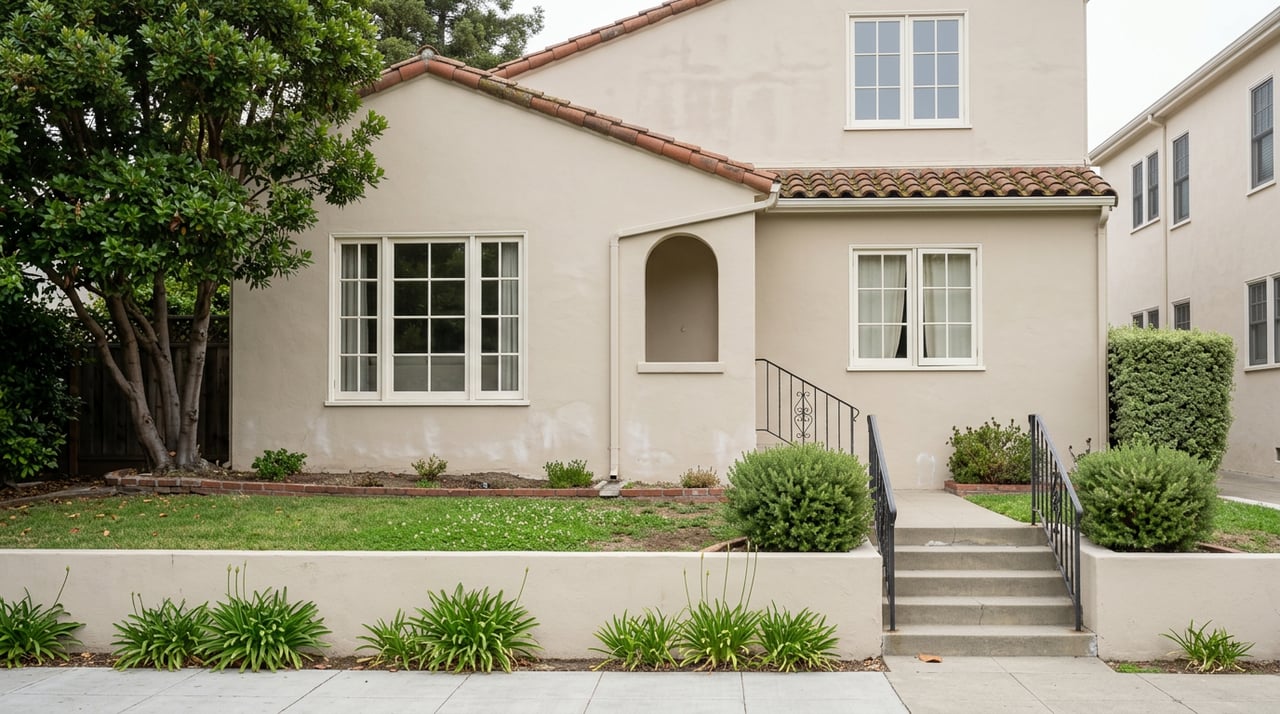
Ingleside Terraces was built on the grounds of the old Ingleside Racetrack, purchased in 1910 by Joseph A. Leonard's Urban Realty Improvement Company and opened as a residence park by 1912. Urbano Drive, the street that loops through the center of the neighborhood, was paved directly on top of the racetrack's original oval. Unlike most San Francisco neighborhoods, which filled in gradually over decades of individual construction, this one was largely built out in a single development push and has changed slowly since.
That matters for pricing because the housing stock is close to fixed. The neighborhood's own homes association counts 742 houses today. Other sources round the figure up to about 750. Either way, there is no meaningful pipeline of new construction adding fresh inventory or fresh sales each year the way there is in neighborhoods still absorbing infill development. Whatever handful of owners decide to sell in a given month is the entire sample that month.
Imagine one recently remodeled home on Urbano Drive selling for $4 million the same month a smaller, unrenovated cottage near Ashton Avenue sells for $1.6 million. Depending on how many other sales close alongside them, that single pairing can swing a monthly median by six figures in either direction. Stretch the window to twelve months and the swings soften, but they never fully disappear, because the underlying pool is still small.
Ingleside Terraces has an active, self-managed community organization, the Ingleside Terraces Homes Association, but it is worth being precise about what that is and is not. ITHA is a 501(c)(4) organization, and according to its own site, dues are annual and voluntary, encouraged rather than required. There is no mandatory assessment showing up in closing costs the way there would be in a condo building or a legally governed HOA subdivision. What ITHA does instead is hold regular meetings, currently scheduled for the third Tuesday of most months excluding the summer and holiday stretch, and steward the neighborhood's shared public spaces, including Sundial Park at Entrada Court, home to the Ingleside Sundial, a San Francisco landmark with a 28-foot gnomon completed in 1913. The association also puts out a long-running community newsletter, The Sundial, and organizes recurring neighborhood events through the year.
For a buyer, the practical takeaway is that community identity here runs on participation rather than enforcement. Nobody is compelled to join or pay, but the group that does has kept the neighborhood's public character remarkably consistent for over a century.
There is a longer-running project inside ITHA that renovation-minded buyers in particular should know about. As of the most recent public reporting, from Ingleside Light in 2024, the association has been pursuing National Register of Historic Places listing for the neighborhood's roughly 750 properties, an effort that traces back to 2008 and was still described at that time as being "at the beginning of the process."
If it succeeds, listing would not prevent new houses from being built in the neighborhood or block the demolition of historic property, according to comments from local historian Woody LaBounty reported in that coverage. It would, however, add a heightened level of city review and consideration, with project proposals going before neighborhood meetings for public comment before changes move forward. It would also open the door to Mills Act property tax benefits for homes that qualify as contributing structures, a real financial consideration for owners planning a long-term restoration rather than a quick flip.
This has been a multi-year, unresolved process for well over a decade, so the honest answer for anyone weighing a purchase with renovation in mind is to ask directly about current status before assuming either outcome.
Given all of this, a single scraped median is close to useless on its own in Ingleside Terraces. A few adjustments make the data far more useful:
Are ITHA dues required to buy here? No. Membership dues are annual and described by the association itself as voluntary but encouraged. There is no legal obligation tied to the property title.
Will a National Register listing stop me from renovating? Based on the most recent reporting, no. It would not prevent new construction or the demolition of historic property, but it would introduce a public review step for project proposals and could make qualifying homes eligible for Mills Act tax treatment.
Why do lot sizes vary so much compared to other San Francisco neighborhoods? Ingleside Terraces was planned from the start as a garden residence park with larger lots and yards, a deliberate design choice from its original 1912 development rather than something that emerged over time.
Pricing in a market this small rewards patience and specifics over headline numbers. If you are weighing a move into Ingleside Terraces, or trying to figure out what your own home there is actually worth against real, current comparables rather than a single portal's snapshot, Mandy Lee can walk through the trailing data street by street. Request a free home valuation to start with numbers built for this neighborhood, not averaged away from it.
Stay up to date on the latest real estate trends.
Innovative real estate maven hailing from the heart of San Francisco. Born and raised in this iconic city, I use my deep local roots with modern strategies, reshaping the real estate landscape. With an intimate knowledge of the city's diverse neighborhoods and a knack for design, she's your guide to finding the perfect property match.